Dysprosium
Lanthanide
Dysprosium (Dy) is a chemical element with atomic number 66, classified as a lanthanide. At room temperature it is a solid. It was discovered in 1886 by Lecoq de Boisbaudran.
Share to Google Classroom (opens in a new tab)Dysprosium quick facts
Is dysprosium a metal, nonmetal or metalloid?
Dysprosium is a metal. It is classified as a lanthanide (rare-earth metal), the 10th of the 15 lanthanides.
What does Dy stand for on the periodic table?
Dy is the chemical symbol for dysprosium, the element with atomic number 66.
What state is dysprosium at room temperature?
Dysprosium is a solid at room temperature (25 °C): it melts at 1407 °C and boils at 2567 °C.
What group, period and block is dysprosium in?
Dysprosium is in period 6, in the f-block, between terbium and holmium. As a lanthanide it sits in the separate row below the main table and is not assigned to one of the numbered groups 1–18.
What is the atomic number and atomic mass of dysprosium?
Dysprosium has atomic number 66, so every dysprosium atom has 66 protons, and its standard atomic mass is 162.5 u.
What is the electron configuration of dysprosium?
The electron configuration of dysprosium is [Xe] 4f¹⁰ 6s².
What is dysprosium used for?
Common uses of dysprosium: magnets, lasers, nuclear reactors, data storage.
Properties
- Atomic number
- 66
- Atomic mass
- 162.5 u
- Category
- Lanthanide
- Group
- None (f-block series)
- Period
- 6
- Block
- f-block
- Electron configuration
- [Xe] 4f¹⁰ 6s²
- Phase at STP
- Solid
- Density
- 8.55 g/cm³
- Melting point
- 1680 K (1406.8 °C)
- Boiling point
- 2840 K (2566.8 °C)
- Electronegativity
- 1.22
- Atomic radius
- 228 pm
- Ionization energy
- 5.939 eV
- Discovery
- 1886 · Lecoq de Boisbaudran
How dysprosium compares with its neighbors
Dysprosium is the 10th of the 15 lanthanides, in the separate f-block row below the main table, between terbium and holmium. Directly below it in the actinide row is californium. Dysprosium is a solid at 25 °C and stays solid until 1,407 °C, 1,382 degrees above room temperature.
Melting and boiling point
Dysprosium melts at 1,407 °C (1,680 K), the 31st highest of the 94 elements with a measured value. In the f-block column it shares with californium, the actinide directly below it, dysprosium’s melting point is higher than californium’s (900 °C). In period 6 it lies between terbium’s melting point (1,356 °C) and holmium’s (1,461 °C) on either side. Its melting point is the 12th highest of the 31 measured in period 6. It boils at 2,567 °C (2,840 K), the 47th highest of the 95 elements with a measured value. In the f-block column it shares with californium, the actinide directly below it, dysprosium’s boiling point is higher than californium’s (1,470 °C). In period 6 it is lower than both terbium just before it (3,230 °C) and holmium just after it (2,720 °C). Its boiling point is the 13th lowest of the 31 measured in period 6. Between melting and boiling, dysprosium stays liquid over a span of 1,160 degrees.
Dysprosium on the melting point chart →Density
Dysprosium has a density of 8.55 g/cm³, the 40th highest of the 97 elements with a measured value. In the f-block column it shares with californium, the actinide directly below it, dysprosium’s density is lower than californium’s (15.1 g/cm³). In period 6 it lies between terbium’s density (8.229 g/cm³) and holmium’s (8.795 g/cm³) on either side. Its density is the 14th lowest of the 31 measured in period 6.
Dysprosium on the density chart →Electronegativity
On the Pauling scale dysprosium has an electronegativity of 1.22, the 22nd lowest of the 94 elements with a measured value. In the f-block column it shares with californium, the actinide directly below it, dysprosium’s electronegativity is lower than californium’s (1.3). From terbium (1.2) just before it to holmium (1.23) just after it, the electronegativity climbs across period 6. Its electronegativity is the 13th lowest of the 31 measured in period 6.
Dysprosium on the electronegativity chart →Atomic radius
A dysprosium atom has a calculated radius of 228 pm, the 20th largest of the 97 elements with a measured value. In the f-block column it shares with californium, the actinide directly below it, dysprosium’s atomic radius is smaller than californium’s (245 pm). In period 6 it is larger than both terbium just before it (225 pm) and holmium just after it (226 pm). Its atomic radius is the 7th largest of the 31 measured in period 6.
Dysprosium on the atomic radius chart →Ionization energy
Removing the outermost electron from a dysprosium atom takes 5.939 eV, the 23rd lowest of the 103 elements with a measured value. In the f-block column it shares with californium, the actinide directly below it, dysprosium’s first ionization energy is lower than californium’s (6.282 eV). In period 6 it lies between terbium’s first ionization energy (5.864 eV) and holmium’s (6.022 eV) on either side. Its first ionization energy is the 12th lowest of the 32 in period 6.
Dysprosium on the ionization energy chart →Discovery in context
When dysprosium was identified in 1886, 17 years after Dmitri Mendeleev published his periodic table in 1869, 72 other elements were already known. Other elements first identified in the 1880s: fluorine (also 1886), germanium (also 1886), praseodymium (1885), neodymium (1885) and gadolinium (1880). Lecoq de Boisbaudran is also credited with discovering gallium and samarium. For comparison in the lanthanide row: californium below it (1950).
Atomic structure
Bohr model of dysprosium
Dysprosium atom: 66 protons, about 97 neutrons and 66 electrons in 6 shells (2, 8, 18, 28, 8, 2). Drag the 3D model to turn it and watch the electrons orbit, or switch to Orbitals to see the real shapes of dysprosium's outer orbitals.
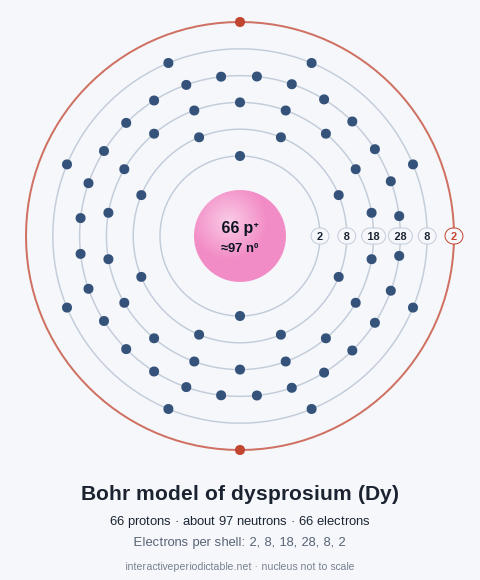
Each ring is an electron shell and each dot an electron; the number on a ring is how many electrons that shell holds. Nucleus not to scale.
Use the arrow keys to rotate the model, plus and minus to zoom, space to pause the electrons and R to reset the view.
How many protons, neutrons and electrons does dysprosium have?
Dysprosium has atomic number 66, so every dysprosium atom has 66 protons in its nucleus. A neutral dysprosium atom has the same number of electrons, 66, arranged in 6 shells: 2, 8, 18, 28, 8, 2.
Dysprosium's average atomic mass is 162.5 u, which rounds to 163. Subtracting the 66 protons leaves about 97 neutrons in a typical dysprosium atom. Atoms of the same element can have different numbers of neutrons (isotopes), so this is an approximate count for a typical atom, not an exact one.
Dysprosium's electron shells and valence electrons
Dysprosium's shell 4 holds 28 electrons (it can hold up to 32), yet shell 5 already has 8: electrons go into the lowest-energy subshell available, and 5s fills before 4f.
Dysprosium is a lanthanide. Its outer shell (shell 6) holds 2 electrons, but electrons in the 4f subshell further in are close in energy and can also take part in bonding, so the number of valence electrons is not as simple as counting the outer shell. Most lanthanides form ions with a 3+ charge.
Dysprosium electron configuration by subshell
In the order the subshells fill. Written out shell by shell, the full configuration is 1s² 2s² 2p⁶ 3s² 3p⁶ 3d¹⁰ 4s² 4p⁶ 4d¹⁰ 4f¹⁰ 5s² 5p⁶ 6s², or [Xe] 4f¹⁰ 6s² for short.
| Subshell | Shell | Electrons | Holds up to |
|---|---|---|---|
| 1s2 | 1 | 2 | 2 |
| 2s2 | 2 | 2 | 2 |
| 2p6 | 2 | 6 | 6 |
| 3s2 | 3 | 2 | 2 |
| 3p6 | 3 | 6 | 6 |
| 4s2 | 4 | 2 | 2 |
| 3d10 | 3 | 10 | 10 |
| 4p6 | 4 | 6 | 6 |
| 5s2 | 5 | 2 | 2 |
| 4d10 | 4 | 10 | 10 |
| 5p6 | 5 | 6 | 6 |
| 6s2 | 6 | 2 | 2 |
| 4f10 | 4 | 10 | 14 |
| Total | 66 | ||
The Bohr model is a simplified picture: electrons do not really travel around the nucleus in neat circles. Quantum mechanics describes them as clouds of probability called orbitals, which is what the Orbitals view shows. Explore any other element in the 3D atom viewer.
Common uses
Magnets, lasers, nuclear reactors, data storage
Did you know?
Critical for wind turbines and electric vehicle motors.
Compare dysprosium with other elements
Side by side with its neighbors on the table:
- Dysprosium vs Californium
- Dysprosium vs Terbium
- Dysprosium vs Holmium
- Compare dysprosium with another element →
Explore dysprosium in the tools
- Dysprosium in the 3D atom viewer · turn the Bohr model and see its orbitals
Experiment with the elements
Dysprosium doesn't form any compounds in our lab yet, but the periodic table sandbox lets you combine dozens of other real elements into real compounds — water, table salt, ammonia and many more — with their true chemical formulas.