3D Atom Viewer
See the Bohr model of any element in 3D: the nucleus of protons and neutrons, and every electron in its shell. Turn it, zoom in, then switch to Orbitals to see the real shapes of the s, p and d orbitals its outer electrons live in. Pick any of the 118 elements below.
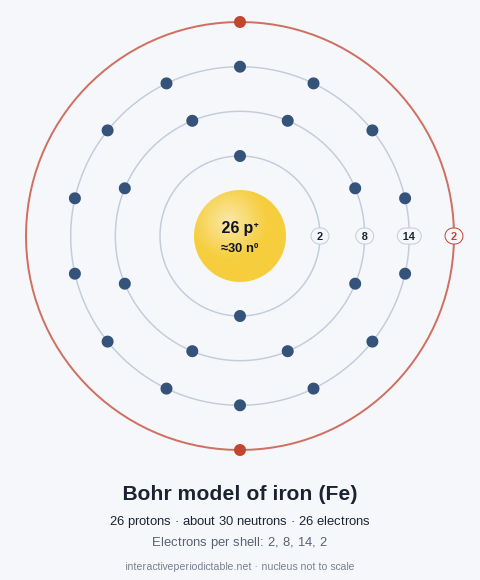
Each ring is an electron shell and each dot an electron; the number on a ring is how many electrons that shell holds. Nucleus not to scale.
Use the arrow keys to rotate the model, plus and minus to zoom, space to pause the electrons and R to reset the view.
Pick an element
Tap any element to load its atom above. Each tile also links to the element's own page, with its Bohr model, electron configuration subshell by subshell, and all its properties.
What the Bohr model shows
In 1913 Niels Bohr pictured the atom as a tiny solar system: a heavy nucleus in the middle, made of protons and neutrons, with electrons moving around it in fixed orbits called shells, or energy levels. The number of protons is the element's atomic number, and a neutral atom has the same number of electrons.
Bohr's idea explained why atoms give out light only in certain colours: when an electron drops from an outer shell to an inner one, it releases a fixed amount of energy. In the viewer, red balls are protons, cream balls are neutrons, and each ring is a shell with its electrons.
Electron shells and valence electrons
Shells are numbered outwards from the nucleus, n = 1, 2, 3 and so on. Shell n can hold at most 2n² electrons:
| Shell (n) | Holds up to (2n²) |
|---|---|
| 1 | 2 |
| 2 | 8 |
| 3 | 18 |
| 4 | 32 |
The shells do not simply fill one after another. Up to calcium the pattern is 2, 8, 8, 2: potassium (2, 8, 8, 1) starts the fourth shell before the third is full, because its 4s subshell is lower in energy than 3d. From scandium on, the 3d subshell fills inside the third shell, which is why iron is 2, 8, 14, 2.
The electrons in the outer shell are the valence electrons, and they decide how an atom bonds. Sodium (2, 8, 1) gives away its single outer electron, chlorine (2, 8, 7) gains one to make eight, and neon (2, 8) already has a full shell, so it does not react. In the viewer the outer shell is the orange ring.
From Bohr to orbitals
In the 1920s quantum mechanics showed that electrons do not follow neat circular paths. Each shell is made of subshells (s, p, d and f), and each subshell of orbitals: regions around the nucleus where an electron is most likely to be found. Think of an orbital as a cloud of probability rather than a track. Each orbital holds at most two electrons.
- s orbitals: one in every shell, shaped like a sphere around the nucleus.
- p orbitals: three in every shell from the second on, each a dumbbell of two lobes along the x, y or z axis.
- d orbitals: five from the third shell on. Four are cloverleaf shapes with four lobes; the fifth, dz², is a dumbbell with a ring around its middle.
- f orbitals: seven from the fourth shell on, with more complex shapes. The viewer lists them for the lanthanides and actinides but does not draw them.
Switch the viewer to Orbitals to see the shapes for the outer subshells of any element: 2s and 2p for carbon, 4s and 3d for iron.
What the model simplifies
- Scale. A real nucleus is tens of thousands of times smaller than its atom: if an atom were the size of a football stadium, its nucleus would be about the size of a pea on the centre spot.
- Paths. Electrons do not circle the nucleus like planets. The rings stand for energy levels; the moving dots only show that the electrons are there.
- The nucleus. Protons and neutrons are drawn as packed balls. For atoms with more than 90 of them, the viewer shows a representative cluster of 90.
- Neutrons. The count shown is for a typical atom: the atomic mass rounded to a whole number, minus the atomic number. Isotopes of the same element have different numbers of neutrons.
- Superheavy elements. From lawrencium (103) on, the electron configurations are predictions, because too few atoms have been made to measure them.
How to draw a Bohr model
- 1
Find the atomic number
It is the number of protons, and of electrons in a neutral atom. Sodium has atomic number 11.
- 2
Work out the neutrons
Round the atomic mass to a whole number and subtract the atomic number: 23 − 11 = 12 for sodium. Write 11 p⁺ and 12 n⁰ in the nucleus.
- 3
Draw the shells
Draw a circle for each shell around the nucleus. The period (row) of the element on the periodic table tells you how many shells it has.
- 4
Add the electrons from the inside out
Put 2 in the first shell, then up to 8 in the second and 8 in the third, for elements up to calcium. Sodium is 2, 8, 1.
- 5
Check the outer shell
Its electrons are the valence electrons. For elements after calcium, look up the electrons per shell on the element page: the third shell can hold up to 18.
Keep exploring
Atoms and the Bohr model: frequently asked questions
What is the Bohr model of an atom?
The Bohr model, proposed by Niels Bohr in 1913, pictures an atom as a small, heavy nucleus of protons and neutrons with electrons moving around it in fixed circular orbits called shells or energy levels. Each shell can hold a limited number of electrons. It is a simplified model, but it explains why atoms give out light only at certain energies and is still the usual way to start learning atomic structure.
How many electrons can each shell hold?
Shell number n can hold at most 2n² electrons: 2 in the first shell, 8 in the second, 18 in the third and 32 in the fourth. For the first 20 elements the shells fill as 2, 8, 8, 2, because the fourth shell starts filling (4s) before the third shell is full (3d). That is why potassium is 2, 8, 8, 1 and iron is 2, 8, 14, 2.
How do you find the number of neutrons in an atom?
Subtract the atomic number (the number of protons) from the mass number. For a typical atom you can round the atomic mass to the nearest whole number: iron has atomic mass 55.845, which rounds to 56, so a typical iron atom has 56 − 26 = 30 neutrons. Atoms of the same element can have different numbers of neutrons, called isotopes, so this is an approximate count.
What are valence electrons?
Valence electrons are the electrons in the outermost shell of an atom. They take part in chemical bonding. For main-group elements the number of valence electrons matches the last digit of the group number: sodium (group 1) has 1, chlorine (group 17) has 7. For transition metals the count is less simple, because electrons in the d subshell of the next shell in can also bond.
What is the difference between the Bohr model and the orbital (quantum) model?
In the Bohr model electrons travel in fixed circular orbits. In the quantum model, electrons have no exact path: they are described by orbitals, regions around the nucleus where an electron is likely to be found. s orbitals are spheres, p orbitals are dumbbells and d orbitals are mostly cloverleaf shapes. The shells of the Bohr model become energy levels made of these orbitals.
Why is the Bohr model still taught if it is not accurate?
Because it gets the most useful ideas right in a simple picture: electrons occupy energy levels, each level holds a limited number of electrons, and the outer electrons decide how an element reacts. It is a good first model of the atom; the orbital model refines it.
Does the 3D atom viewer work on school Chromebooks?
Yes. It runs in any modern browser with nothing to install, including Chromebooks, iPads and phones. If a device cannot show 3D graphics, the viewer shows the 2D Bohr diagram instead, and every diagram can be downloaded as an SVG image for worksheets and slides.
Explore our learning apps
One good question leads to another. Discover more free, interactive learning tools from the same maker.
Astronomy Lab
Follow an orbit, explore Moon phases, and discover the worlds beyond our own.
Explore spaceGeometry Lab
Move a point, solve a triangle, and watch angles, shapes, and formulas make sense.
Explore mathBiology Lab
Cross two parents, translate a gene into protein, and watch a population grow.
Explore biologyKidsCode
Guide a robot, snap code blocks together, and make your first real Python programs.
Explore codingPhysics Lab
Launch a ball, catch a wave, and experiment with motion, forces, light, and electricity.
Explore physicsEarth Science Lab
Find an earthquake, move plates, carve a river, and follow water and rock through Earth’s cycles.
Explore earth scienceCell by Cell
Learn Excel by doing. Type real formulas in a live spreadsheet and have each step checked as you work.
Explore spreadsheetsFiction & Fact Library
Build a plot diagram, sort facts from opinions, tag the parts of speech, and read fables aloud.
Explore reading