Hassium
Transition Metal
Hassium (Hs) is a chemical element with atomic number 108, classified as a transition metal. At room temperature it is a solid. It was discovered in 1984 by Gesellschaft für Schwerionenforschung (GSI).
Share to Google Classroom (opens in a new tab)Hassium quick facts
Is hassium a metal, nonmetal or metalloid?
Hassium is expected to be a metal: it sits with the transition metals on the periodic table, below osmium. Only a handful of its atoms have ever been made, so its chemistry is largely predicted rather than observed.
What does Hs stand for on the periodic table?
Hs is the chemical symbol for hassium, the element with atomic number 108.
What state is hassium at room temperature?
Nobody knows for sure: only a few atoms of hassium have ever been made, and every known isotope is radioactive. It is usually listed as a solid based on theoretical predictions.
What group, period and block is hassium in?
Hassium is in group 8 and period 7 of the periodic table, in the d-block.
What is the atomic number and atomic mass of hassium?
Hassium has atomic number 108, so every hassium atom has 108 protons. It has no stable isotopes, so tables list the mass number of its most stable isotope, 277, in brackets: [277].
What is the electron configuration of hassium?
The predicted electron configuration of hassium is [Rn] 5f¹⁴ 6d⁶ 7s².
What is hassium used for?
Hassium has no uses outside scientific research: it is made only a few atoms at a time in particle accelerators.
Properties
- Atomic number
- 108
- Atomic mass (most stable isotope)
- [277]
- Category
- Transition Metal
- Group
- 8
- Period
- 7
- Block
- d-block
- Electron configuration
- [Rn] 5f¹⁴ 6d⁶ 7s²
- Phase at STP
- Solid
- Density
- 40.7 g/cm³
- Melting point
- —
- Boiling point
- —
- Electronegativity
- —
- Atomic radius
- —
- Ionization energy
- —
- Discovery
- 1984 · Gesellschaft für Schwerionenforschung (GSI)
How hassium compares with its neighbors
Hassium, a transition metal, is in group 8, period 7 (d-block), between bohrium and meitnerium. It is the heaviest known member of group 8, below osmium. Nobody has seen a piece of hassium, because only a few atoms have ever been made, so its state at 25 °C is a prediction: it is expected to be a solid, like osmium above it.
Melting and boiling point
Hassium’s melting point has not been measured, because only a few atoms have ever been made; for comparison, osmium, directly above it, has a measured value of 3,033 °C. Hassium’s boiling point has not been measured, because only a few atoms have ever been made; for comparison, osmium, directly above it, has a measured value of 5,012 °C.
Hassium on the melting point chart →Density
Hassium’s density has not been measured, because only a few atoms have ever been made, so the figure usually listed, 40.7 g/cm³, is an estimate, higher than the measured 22.61 g/cm³ of osmium, directly above it.
Hassium on the density chart →Electronegativity
Hassium’s electronegativity has not been measured, because only a few atoms have ever been made; for comparison, osmium, directly above it, has a measured value of 2.2.
Hassium on the electronegativity chart →Atomic radius
Hassium’s atomic radius has not been measured, because only a few atoms have ever been made; for comparison, osmium, directly above it, has a measured value of 185 pm.
Hassium on the atomic radius chart →Ionization energy
Hassium’s first ionization energy has not been measured, because only a few atoms have ever been made; for comparison, osmium, directly above it, has a measured value of 8.438 eV.
Hassium on the ionization energy chart →Discovery in context
When hassium was identified in 1984, 115 years after Dmitri Mendeleev published his periodic table in 1869, 108 other elements were already known. Other elements first identified in the 1980s: bohrium (1981) and meitnerium (1982). Gesellschaft für Schwerionenforschung (GSI) is also credited with discovering bohrium, meitnerium, darmstadtium, roentgenium and copernicium. For comparison in group 8: osmium above it (1803).
Atomic structure
Bohr model of hassium
Hassium atom: 108 protons, about 169 neutrons and 108 electrons in 7 shells (2, 8, 18, 32, 32, 14, 2). Drag the 3D model to turn it and watch the electrons orbit, or switch to Orbitals to see the real shapes of hassium's outer orbitals.
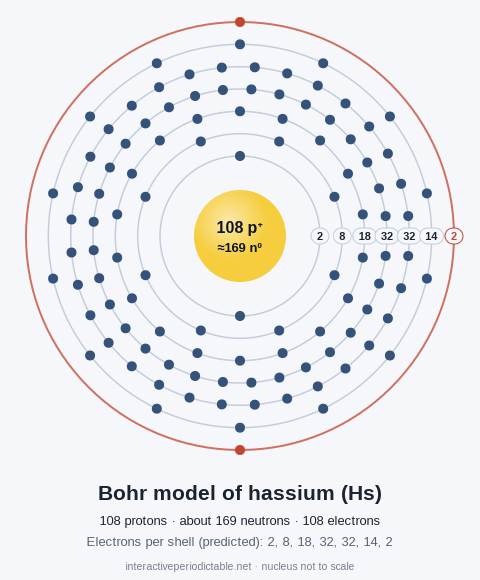
Each ring is an electron shell and each dot an electron; the number on a ring is how many electrons that shell holds. Nucleus not to scale.
Use the arrow keys to rotate the model, plus and minus to zoom, space to pause the electrons and R to reset the view.
How many protons, neutrons and electrons does hassium have?
Hassium has atomic number 108, so every hassium atom has 108 protons in its nucleus. A neutral hassium atom has the same number of electrons, 108, arranged in 7 shells: 2, 8, 18, 32, 32, 14, 2.
Hassium has no stable isotopes. Its most stable known isotope, hassium-277, has 277 − 108 = 169 neutrons, so that is the count shown here. Other isotopes of hassium have different numbers of neutrons.
Hassium's electron shells and valence electrons
Hassium has 2 electrons in its outer shell (shell 7). Like the transition metals above it, its 6d electrons are expected to take part in bonding too, but only a few atoms have ever been made, so its chemistry is predicted rather than observed.
Hassium's electron configuration has not been measured: it is predicted from theory, because too few atoms have ever been made to study it.
Hassium electron configuration by subshell
In the order the subshells fill (predicted). Written out shell by shell, the full configuration is 1s² 2s² 2p⁶ 3s² 3p⁶ 3d¹⁰ 4s² 4p⁶ 4d¹⁰ 4f¹⁴ 5s² 5p⁶ 5d¹⁰ 5f¹⁴ 6s² 6p⁶ 6d⁶ 7s², or [Rn] 5f¹⁴ 6d⁶ 7s² for short.
| Subshell | Shell | Electrons | Holds up to |
|---|---|---|---|
| 1s2 | 1 | 2 | 2 |
| 2s2 | 2 | 2 | 2 |
| 2p6 | 2 | 6 | 6 |
| 3s2 | 3 | 2 | 2 |
| 3p6 | 3 | 6 | 6 |
| 4s2 | 4 | 2 | 2 |
| 3d10 | 3 | 10 | 10 |
| 4p6 | 4 | 6 | 6 |
| 5s2 | 5 | 2 | 2 |
| 4d10 | 4 | 10 | 10 |
| 5p6 | 5 | 6 | 6 |
| 6s2 | 6 | 2 | 2 |
| 4f14 | 4 | 14 | 14 |
| 5d10 | 5 | 10 | 10 |
| 6p6 | 6 | 6 | 6 |
| 7s2 | 7 | 2 | 2 |
| 5f14 | 5 | 14 | 14 |
| 6d6 | 6 | 6 | 10 |
| Total | 108 | ||
The Bohr model is a simplified picture: electrons do not really travel around the nucleus in neat circles. Quantum mechanics describes them as clouds of probability called orbitals, which is what the Orbitals view shows. Explore any other element in the 3D atom viewer.
Common uses
Research only
Did you know?
Named after Hesse, Germany and extremely unstable.
Compare hassium with other elements
Side by side with its neighbors on the table:
Explore hassium in the tools
- Hassium in the 3D atom viewer · turn the Bohr model and see its orbitals
Experiment with the elements
Hassium doesn't form any compounds in our lab yet, but the periodic table sandbox lets you combine dozens of other real elements into real compounds — water, table salt, ammonia and many more — with their true chemical formulas.