Neptunium
Actinide
Neptunium (Np) is a chemical element with atomic number 93, classified as a actinide. At room temperature it is a solid. It was discovered in 1940 by Edwin McMillan, Philip Abelson.
Share to Google Classroom (opens in a new tab)Neptunium quick facts
Is neptunium a metal, nonmetal or metalloid?
Neptunium is a metal. It is classified as an actinide metal, the 5th of the 15 actinides.
What does Np stand for on the periodic table?
Np is the chemical symbol for neptunium, the element with atomic number 93.
What state is neptunium at room temperature?
Neptunium is a solid at room temperature (25 °C): it melts at 644 °C and boils at 4000 °C.
What group, period and block is neptunium in?
Neptunium is in period 7, in the f-block, between uranium and plutonium. As an actinide it sits in the separate row below the main table and is not assigned to one of the numbered groups 1–18.
What is the atomic number and atomic mass of neptunium?
Neptunium has atomic number 93, so every neptunium atom has 93 protons. It has no stable isotopes, so tables list the mass number of its most stable isotope, 237, in brackets: [237].
What is the electron configuration of neptunium?
The electron configuration of neptunium is [Rn] 5f⁴ 6d¹ 7s².
What is neptunium used for?
Common uses of neptunium: nuclear reactors, research, neutron detectors.
Properties
- Atomic number
- 93
- Atomic mass (most stable isotope)
- [237]
- Category
- Actinide
- Group
- None (f-block series)
- Period
- 7
- Block
- f-block
- Electron configuration
- [Rn] 5f⁴ 6d¹ 7s²
- Phase at STP
- Solid
- Density
- 20.45 g/cm³
- Melting point
- 917 K (643.9 °C)
- Boiling point
- 4273 K (3999.8 °C)
- Electronegativity
- 1.36
- Atomic radius
- 221 pm
- Ionization energy
- 6.266 eV
- Discovery
- 1940 · Edwin McMillan, Philip Abelson
How neptunium compares with its neighbors
Neptunium is the 5th of the 15 actinides, in the separate f-block row below the main table, between uranium and plutonium. Directly above it in the lanthanide row is promethium. Neptunium is a solid at 25 °C and stays solid until 644 °C, 619 degrees above room temperature.
Melting and boiling point
Neptunium melts at 644 °C (917 K), the 34th lowest of the 94 elements with a measured value. In the f-block column it shares with promethium, the lanthanide directly above it, neptunium’s melting point is lower than promethium’s (1,042 °C). In period 7 it lies between uranium’s melting point (1,132 °C) and plutonium’s (639 °C) on either side. Its melting point is the 2nd lowest of the 12 measured in period 7. It boils at 4,000 °C (4,273 K), the 15th highest of the 95 elements with a measured value. In the f-block column it shares with promethium, the lanthanide directly above it, neptunium’s boiling point is higher than promethium’s (3,000 °C). From uranium (4,131 °C) just before it to plutonium (3,228 °C) just after it, the boiling point drops across period 7. Its boiling point is the 4th highest of the 12 measured in period 7. Between melting and boiling, neptunium stays liquid over a span of 3,356 degrees, the widest liquid range of any element with measured values.
Neptunium on the melting point chart →Density
Neptunium has a density of 20.45 g/cm³, the 5th highest of the 97 elements with a measured value. In the f-block column it shares with promethium, the lanthanide directly above it, neptunium’s density is higher than promethium’s (7.26 g/cm³). In period 7 it is higher than both uranium just before it (18.95 g/cm³) and plutonium just after it (19.84 g/cm³). Its density is the highest measured in period 7.
Neptunium on the density chart →Electronegativity
On the Pauling scale neptunium has an electronegativity of 1.36, the 37th lowest of the 94 elements with a measured value. In the f-block column it shares with promethium, the lanthanide directly above it, neptunium’s electronegativity is higher than promethium’s (1.13). From uranium (1.38) just before it to plutonium (1.28) just after it, the electronegativity drops across period 7. Its electronegativity is the 3rd highest of the 12 measured in period 7.
Neptunium on the electronegativity chart →Atomic radius
A neptunium atom has a calculated radius of 221 pm, the 27th largest of the 97 elements with a measured value. In the f-block column it shares with promethium, the lanthanide directly above it, neptunium’s atomic radius is larger than promethium’s (205 pm). In period 7 it is smaller than both uranium just before it (240 pm) and plutonium just after it (243 pm). Its atomic radius is the smallest measured in period 7.
Neptunium on the atomic radius chart →Ionization energy
Removing the outermost electron from a neptunium atom takes 6.266 eV, the 39th lowest of the 103 elements with a measured value. In the f-block column it shares with promethium, the lanthanide directly above it, neptunium’s first ionization energy is higher than promethium’s (5.582 eV). In period 7 it is higher than both uranium just before it (6.194 eV) and plutonium just after it (6.026 eV). Its first ionization energy is the 7th highest of the 17 measured in period 7.
Neptunium on the ionization energy chart →Discovery in context
When neptunium was identified in 1940, 71 years after Dmitri Mendeleev published his periodic table in 1869, 90 other elements were already known. Other elements first identified in the 1940s: astatine (also 1940), plutonium (also 1940), promethium (1945), americium (1944), curium (1944) and berkelium (1949). For comparison in the actinide row: promethium above it (1945).
Atomic structure
Bohr model of neptunium
Neptunium atom: 93 protons, about 144 neutrons and 93 electrons in 7 shells (2, 8, 18, 32, 22, 9, 2). Drag the 3D model to turn it and watch the electrons orbit, or switch to Orbitals to see the real shapes of neptunium's outer orbitals.
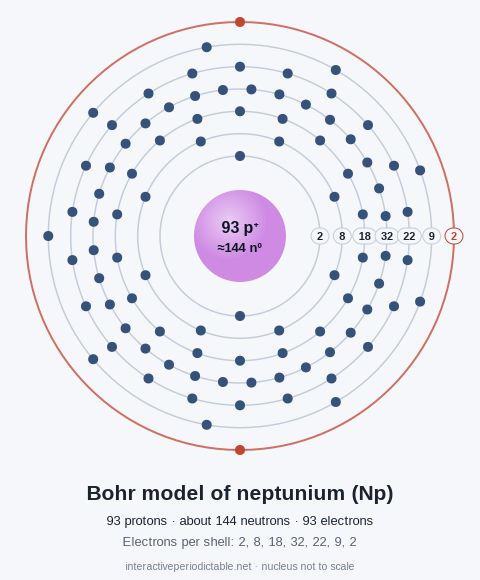
Each ring is an electron shell and each dot an electron; the number on a ring is how many electrons that shell holds. Nucleus not to scale.
Use the arrow keys to rotate the model, plus and minus to zoom, space to pause the electrons and R to reset the view.
How many protons, neutrons and electrons does neptunium have?
Neptunium has atomic number 93, so every neptunium atom has 93 protons in its nucleus. A neutral neptunium atom has the same number of electrons, 93, arranged in 7 shells: 2, 8, 18, 32, 22, 9, 2.
Neptunium has no stable isotopes. Its most stable known isotope, neptunium-237, has 237 − 93 = 144 neutrons, so that is the count shown here. Other isotopes of neptunium have different numbers of neutrons.
Neptunium's electron shells and valence electrons
Neptunium's shell 5 holds 22 electrons, yet shell 6 already has 9: electrons go into the lowest-energy subshell available, and 6s fills before 5f.
Neptunium is an actinide. Its outer shell (shell 7) holds 2 electrons, but electrons in the 5f and 6d subshells further in are close in energy and can also take part in bonding, so the number of valence electrons is not as simple as counting the outer shell. Actinides show a wide range of charges in their compounds.
Neptunium is one of the exceptions to the usual filling order. The simple rule predicts [Rn] 5f⁵ 7s², but the actual ground state of neptunium is [Rn] 5f⁴ 6d¹ 7s²: the 5f and 6d subshells are so close in energy that this arrangement is more stable.
Neptunium electron configuration by subshell
In the order the subshells fill. Written out shell by shell, the full configuration is 1s² 2s² 2p⁶ 3s² 3p⁶ 3d¹⁰ 4s² 4p⁶ 4d¹⁰ 4f¹⁴ 5s² 5p⁶ 5d¹⁰ 5f⁴ 6s² 6p⁶ 6d¹ 7s², or [Rn] 5f⁴ 6d¹ 7s² for short.
| Subshell | Shell | Electrons | Holds up to |
|---|---|---|---|
| 1s2 | 1 | 2 | 2 |
| 2s2 | 2 | 2 | 2 |
| 2p6 | 2 | 6 | 6 |
| 3s2 | 3 | 2 | 2 |
| 3p6 | 3 | 6 | 6 |
| 4s2 | 4 | 2 | 2 |
| 3d10 | 3 | 10 | 10 |
| 4p6 | 4 | 6 | 6 |
| 5s2 | 5 | 2 | 2 |
| 4d10 | 4 | 10 | 10 |
| 5p6 | 5 | 6 | 6 |
| 6s2 | 6 | 2 | 2 |
| 4f14 | 4 | 14 | 14 |
| 5d10 | 5 | 10 | 10 |
| 6p6 | 6 | 6 | 6 |
| 7s2 | 7 | 2 | 2 |
| 5f4 | 5 | 4 | 14 |
| 6d1 | 6 | 1 | 10 |
| Total | 93 | ||
The Bohr model is a simplified picture: electrons do not really travel around the nucleus in neat circles. Quantum mechanics describes them as clouds of probability called orbitals, which is what the Orbitals view shows. Explore any other element in the 3D atom viewer.
Common uses
Nuclear reactors, research, neutron detectors
Did you know?
First transuranium element discovered and named after Neptune.
Compare neptunium with other elements
Side by side with its neighbors on the table:
- Neptunium vs Promethium
- Neptunium vs Uranium
- Neptunium vs Plutonium
- Compare neptunium with another element →
Explore neptunium in the tools
- Neptunium in the 3D atom viewer · turn the Bohr model and see its orbitals
Experiment with the elements
Neptunium doesn't form any compounds in our lab yet, but uranium, just before it in the period, appears in two compounds, uranium hexafluoride (UF₆) and uranium dioxide (UO₂). Make them in the periodic table sandbox, where real elements combine into real compounds with their true chemical formulas.