Krypton
Noble Gas
Krypton (Kr) is a chemical element with atomic number 36, classified as a noble gas. At room temperature it is a gas. It was discovered in 1898 by William Ramsay, Morris Travers.
Share to Google Classroom (opens in a new tab)Krypton quick facts
Is krypton a metal, nonmetal or metalloid?
Krypton is a nonmetal. It is classified as a noble gas.
What does Kr stand for on the periodic table?
Kr is the chemical symbol for krypton, the element with atomic number 36.
What state is krypton at room temperature?
Krypton is a gas at room temperature (25 °C): it melts at -157 °C and boils at -153 °C.
What group, period and block is krypton in?
Krypton is in group 18 and period 4 of the periodic table, in the p-block.
What is the atomic number and atomic mass of krypton?
Krypton has atomic number 36, so every krypton atom has 36 protons, and its standard atomic mass is 83.798 u.
What is the electron configuration of krypton?
The electron configuration of krypton is [Ar] 3d¹⁰ 4s² 4p⁶.
What is krypton used for?
Common uses of krypton: high-performance light bulbs, lasers, insulating windows.
Properties
- Atomic number
- 36
- Atomic mass
- 83.798 u
- Category
- Noble Gas
- Group
- 18
- Period
- 4
- Block
- p-block
- Electron configuration
- [Ar] 3d¹⁰ 4s² 4p⁶
- Phase at STP
- Gas
- Density
- 3.733 g/L
- Melting point
- 115.79 K (-157.4 °C)
- Boiling point
- 119.93 K (-153.2 °C)
- Electronegativity
- 3
- Atomic radius
- 88 pm
- Ionization energy
- 14 eV
- Discovery
- 1898 · William Ramsay, Morris Travers
How krypton compares with its neighbors
Krypton, a noble gas, is in group 18, period 4 (p-block), at the end of period 4, after bromine. Argon sits above it and xenon below it. Krypton is a gas at 25 °C because it exists as single atoms that barely attract each other: it boils at −153 °C, 178 degrees below room temperature.
Melting and boiling point
Krypton melts at −157 °C (115.79 K), the 7th lowest of the 94 elements with a measured value. Down group 18, the melting point climbs from argon (−189 °C) through krypton to xenon (−112 °C). As the last element of period 4, it follows bromine, which has a higher melting point (−7.3 °C). Its melting point is the 3rd highest of the 6 measured in group 18 and the lowest in period 4. It boils at −153 °C (119.93 K), the 8th lowest of the 95 elements with a measured value. In group 18, krypton’s boiling point lies between argon’s (−186 °C) above it and xenon’s (−108 °C) below it. As the last element of period 4, it follows bromine, which has a higher boiling point (58.9 °C). Its boiling point is the 3rd highest of the 6 measured in group 18 and the lowest in period 4. Between melting and boiling, krypton stays liquid over a span of 4.1 degrees, the 4th narrowest of the 94 elements with both values measured.
Krypton on the melting point chart →Density
Krypton has a density of 0.00373 g/cm³ as a gas at 0 °C, the 9th lowest of the 97 elements with a measured value. Down group 18, the density climbs from argon (0.00178 g/cm³) through krypton to xenon (0.00589 g/cm³). As the last element of period 4, it follows bromine, which has a higher density (3.122 g/cm³). Its density is the 3rd highest of the 6 measured in group 18 and the lowest in period 4.
Krypton on the density chart →Electronegativity
On the Pauling scale krypton has an electronegativity of 3, the 5th highest of the 94 elements with a measured value. Xenon, directly below krypton in group 18, has a lower electronegativity (2.6), in line with the usual fall in electronegativity down a group; argon, above it, has no measured value. As the last element of period 4, it follows bromine, which has a lower electronegativity (2.96), as electronegativity usually rises across a period. Its electronegativity is the highest measured in group 18 and the highest in period 4.
Krypton on the electronegativity chart →Atomic radius
A krypton atom has a calculated radius of 88 pm, the 11th smallest of the 97 elements with a measured value. In group 18, krypton’s atomic radius lies between argon’s (71 pm) above it and xenon’s (108 pm) below it, in line with atoms growing down a group as electron shells are added. As the last element of period 4, it follows bromine, which has a larger atomic radius (94 pm), as atoms usually shrink across a period while the nuclear charge grows. Its atomic radius is the 3rd largest of the 6 measured in group 18 and the smallest in period 4.
Krypton on the atomic radius chart →Ionization energy
Removing the outermost electron from a krypton atom takes 14 eV, the 6th highest of the 103 elements with a measured value. Down group 18, the first ionization energy drops from argon (15.76 eV) through krypton to xenon (12.13 eV), in line with the usual fall down a group, as the outer electron sits further from the nucleus. As the last element of period 4, it follows bromine, which has a lower first ionization energy (11.814 eV), as ionization energy usually rises across a period. Its first ionization energy is the 3rd lowest of the 6 measured in group 18 and the highest in period 4.
Krypton on the ionization energy chart →Discovery in context
When krypton was identified in 1898, 29 years after Dmitri Mendeleev published his periodic table in 1869, 76 other elements were already known. Other elements first identified in the 1890s: neon (also 1898), xenon (also 1898), polonium (also 1898), radium (also 1898), argon (1894) and actinium (1899). William Ramsay is also credited with discovering neon, argon and xenon. Morris Travers is also credited with discovering neon and xenon. For comparison in group 18: argon above it (1894) and xenon below it (1898).
Atomic structure
Bohr model of krypton
Krypton atom: 36 protons, about 48 neutrons and 36 electrons in 4 shells (2, 8, 18, 8). Drag the 3D model to turn it and watch the electrons orbit, or switch to Orbitals to see the real shapes of krypton's outer orbitals.
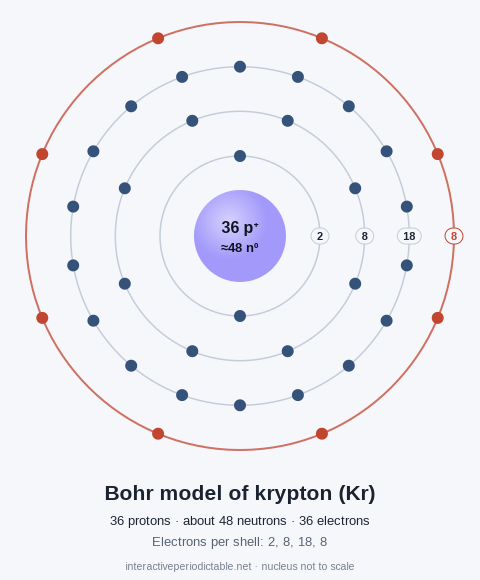
Each ring is an electron shell and each dot an electron; the number on a ring is how many electrons that shell holds. Nucleus not to scale.
Use the arrow keys to rotate the model, plus and minus to zoom, space to pause the electrons and R to reset the view.
How many protons, neutrons and electrons does krypton have?
Krypton has atomic number 36, so every krypton atom has 36 protons in its nucleus. A neutral krypton atom has the same number of electrons, 36, arranged in 4 shells: 2, 8, 18, 8.
Krypton's average atomic mass is 83.798 u, which rounds to 84. Subtracting the 36 protons leaves about 48 neutrons in a typical krypton atom. Atoms of the same element can have different numbers of neutrons (isotopes), so this is an approximate count for a typical atom, not an exact one.
Krypton's electron shells and valence electrons
Krypton has 8 valence electrons in its outer shell (shell 4): a full set, which is why the noble gases hardly react.
Krypton electron configuration by subshell
In the order the subshells fill. Written out shell by shell, the full configuration is 1s² 2s² 2p⁶ 3s² 3p⁶ 3d¹⁰ 4s² 4p⁶, or [Ar] 3d¹⁰ 4s² 4p⁶ for short.
| Subshell | Shell | Electrons | Holds up to |
|---|---|---|---|
| 1s2 | 1 | 2 | 2 |
| 2s2 | 2 | 2 | 2 |
| 2p6 | 2 | 6 | 6 |
| 3s2 | 3 | 2 | 2 |
| 3p6 | 3 | 6 | 6 |
| 4s2 | 4 | 2 | 2 |
| 3d10 | 3 | 10 | 10 |
| 4p6 | 4 | 6 | 6 |
| Total | 36 | ||
The Bohr model is a simplified picture: electrons do not really travel around the nucleus in neat circles. Quantum mechanics describes them as clouds of probability called orbitals, which is what the Orbitals view shows. Explore any other element in the 3D atom viewer.
Common uses
High-performance light bulbs, lasers, insulating windows
Did you know?
Named after Greek word for 'hidden' and used in Superman's home planet.
Compare krypton with other elements
Side by side with its neighbors on the table:
Explore krypton in the tools
- Krypton in the 3D atom viewer · turn the Bohr model and see its orbitals
Compounds you can make with krypton
Krypton appears in one compound in our periodic table sandbox. Each one is a real substance with its true chemical formula — combine the right elements in the right ratio below to discover it.
-
KrF2
Krypton Difluoride
A rare compound of a "noble" gas, only stable when kept extremely cold.