Phosphorus
Reactive Nonmetal
Phosphorus (P) is a chemical element with atomic number 15, classified as a reactive nonmetal. At room temperature it is a solid. It was discovered in 1669 by Hennig Brand.
Share to Google Classroom (opens in a new tab)Phosphorus quick facts
Is phosphorus a metal, nonmetal or metalloid?
Phosphorus is a nonmetal. It is classified as a reactive nonmetal.
What does P stand for on the periodic table?
P is the chemical symbol for phosphorus, the element with atomic number 15.
What state is phosphorus at room temperature?
Phosphorus is a solid at room temperature (25 °C): it melts at 44.2 °C and boils at 281 °C.
What group, period and block is phosphorus in?
Phosphorus is in group 15 and period 3 of the periodic table, in the p-block.
What is the atomic number and atomic mass of phosphorus?
Phosphorus has atomic number 15, so every phosphorus atom has 15 protons, and its standard atomic mass is 30.974 u.
What is the electron configuration of phosphorus?
The electron configuration of phosphorus is [Ne] 3s² 3p³.
What is phosphorus used for?
Common uses of phosphorus: fertilizers, matches, fireworks, DNA/RNA, bones and teeth.
Properties
- Atomic number
- 15
- Atomic mass
- 30.974 u
- Category
- Reactive Nonmetal
- Group
- 15
- Period
- 3
- Block
- p-block
- Electron configuration
- [Ne] 3s² 3p³
- Phase at STP
- Solid
- Density
- 1.82 g/cm³
- Melting point
- 317.3 K (44.2 °C)
- Boiling point
- 553.65 K (280.5 °C)
- Electronegativity
- 2.19
- Atomic radius
- 98 pm
- Ionization energy
- 10.487 eV
- Discovery
- 1669 · Hennig Brand
How phosphorus compares with its neighbors
Phosphorus, a reactive nonmetal, is in group 15, period 3 (p-block), between silicon and sulfur. Nitrogen sits above it and arsenic below it. Phosphorus is a nonmetal, while silicon and arsenic are metalloids: it sits near a border between kinds of element. Phosphorus is a solid at 25 °C, but only just: it melts at 44.2 °C, 19.2 degrees above room temperature.
Melting and boiling point
Phosphorus melts at 44.2 °C (317.3 K), the 16th lowest of the 94 elements with a measured value. Down group 15, the melting point climbs from nitrogen (−210 °C) through phosphorus to arsenic (817 °C). In period 3 it is lower than both silicon just before it (1,414 °C) and sulfur just after it (115 °C). Its melting point is the 2nd lowest of the 5 measured in group 15 and the 3rd lowest of the 8 in period 3. It boils at 281 °C (553.65 K), the 14th lowest of the 95 elements with a measured value. In group 15, phosphorus’s boiling point lies between nitrogen’s (−196 °C) above it and arsenic’s (614 °C) below it. In period 3 it is lower than both silicon just before it (3,265 °C) and sulfur just after it (445 °C). Its boiling point is the 2nd lowest of the 5 measured in group 15 and the 3rd lowest of the 8 in period 3. Between melting and boiling, phosphorus stays liquid over a span of 236 degrees.
Phosphorus on the melting point chart →Density
Phosphorus has a density of 1.82 g/cm³, the 18th lowest of the 97 elements with a measured value. Down group 15, the density climbs from nitrogen (0.00125 g/cm³) through phosphorus to arsenic (5.776 g/cm³). In period 3 it is lower than both silicon just before it (2.33 g/cm³) and sulfur just after it (2.067 g/cm³). Its density is the 2nd lowest of the 5 measured in group 15 and the 4th highest of the 8 in period 3.
Phosphorus on the density chart →Electronegativity
On the Pauling scale phosphorus has an electronegativity of 2.19, the 23rd highest of the 94 elements with a measured value. In group 15, phosphorus’s electronegativity lies between nitrogen’s (3.04) above it and arsenic’s (2.18) below it, in line with the usual fall in electronegativity down a group. From silicon (1.9) just before it to sulfur (2.58) just after it, the electronegativity climbs across period 3, as electronegativity usually rises across a period. Its electronegativity is the 2nd highest of the 5 measured in group 15 and the 3rd highest of the 7 measured in period 3.
Phosphorus on the electronegativity chart →Atomic radius
A phosphorus atom has a calculated radius of 98 pm, the 14th smallest of the 97 elements with a measured value. In group 15, phosphorus’s atomic radius lies between nitrogen’s (56 pm) above it and arsenic’s (114 pm) below it, in line with atoms growing down a group as electron shells are added. From silicon (111 pm) just before it to sulfur (88 pm) just after it, the atomic radius drops across period 3, as atoms usually shrink across a period while the nuclear charge grows. Its atomic radius is the 2nd smallest of the 5 measured in group 15 and the 4th smallest of the 8 in period 3.
Phosphorus on the atomic radius chart →Ionization energy
Removing the outermost electron from a phosphorus atom takes 10.487 eV, the 14th highest of the 103 elements with a measured value. Down group 15, the first ionization energy drops from nitrogen (14.534 eV) through phosphorus to arsenic (9.815 eV), in line with the usual fall down a group, as the outer electron sits further from the nucleus. In period 3 it is higher than both silicon just before it (8.152 eV) and sulfur just after it (10.36 eV). Its first ionization energy is the 2nd highest of the 5 measured in group 15 and the 3rd highest of the 8 in period 3.
Phosphorus on the ionization energy chart →Discovery in context
When phosphorus was identified in 1669, 200 years before Dmitri Mendeleev published his periodic table in 1869, 11 other elements were already known. For comparison in group 15: nitrogen above it (1772) and arsenic below it (1250).
Atomic structure
Bohr model of phosphorus
Phosphorus atom: 15 protons, about 16 neutrons and 15 electrons in 3 shells (2, 8, 5). Drag the 3D model to turn it and watch the electrons orbit, or switch to Orbitals to see the real shapes of phosphorus's outer orbitals.
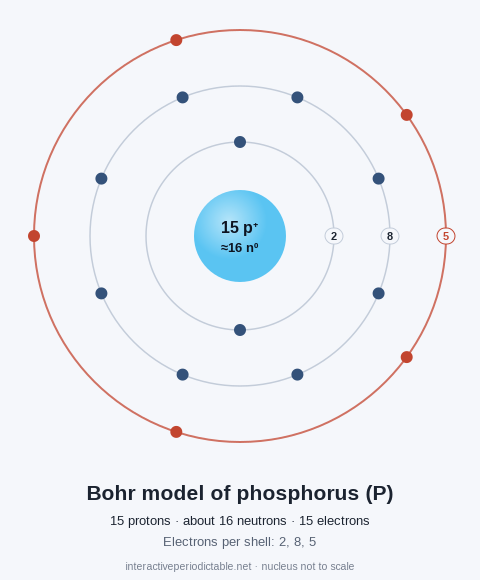
Each ring is an electron shell and each dot an electron; the number on a ring is how many electrons that shell holds. Nucleus not to scale.
Use the arrow keys to rotate the model, plus and minus to zoom, space to pause the electrons and R to reset the view.
How many protons, neutrons and electrons does phosphorus have?
Phosphorus has atomic number 15, so every phosphorus atom has 15 protons in its nucleus. A neutral phosphorus atom has the same number of electrons, 15, arranged in 3 shells: 2, 8, 5.
Phosphorus's average atomic mass is 30.974 u, which rounds to 31. Subtracting the 15 protons leaves about 16 neutrons in a typical phosphorus atom. Atoms of the same element can have different numbers of neutrons (isotopes), so this is an approximate count for a typical atom, not an exact one.
Phosphorus's electron shells and valence electrons
Phosphorus has 5 valence electrons in its outer shell (shell 3). These are the electrons that take part in chemical bonds.
Phosphorus electron configuration by subshell
In the order the subshells fill. Written out shell by shell, the full configuration is 1s² 2s² 2p⁶ 3s² 3p³, or [Ne] 3s² 3p³ for short.
| Subshell | Shell | Electrons | Holds up to |
|---|---|---|---|
| 1s2 | 1 | 2 | 2 |
| 2s2 | 2 | 2 | 2 |
| 2p6 | 2 | 6 | 6 |
| 3s2 | 3 | 2 | 2 |
| 3p3 | 3 | 3 | 6 |
| Total | 15 | ||
The Bohr model is a simplified picture: electrons do not really travel around the nucleus in neat circles. Quantum mechanics describes them as clouds of probability called orbitals, which is what the Orbitals view shows. Explore any other element in the 3D atom viewer.
Common uses
Fertilizers, matches, fireworks, DNA/RNA, bones and teeth
Did you know?
Glows in the dark when exposed to oxygen and is essential for all life.
Compare phosphorus with other elements
Comparison guides that explain the differences:
Side by side with its neighbors on the table:
- Phosphorus vs Arsenic
- Phosphorus vs Silicon
- Phosphorus vs Sulfur
- Compare phosphorus with another element →
Explore phosphorus in the tools
- Phosphorus in the 3D atom viewer · turn the Bohr model and see its orbitals
- Making calcium phosphate · balance Ca(OH)2 + H3PO4 → Ca3(PO4)2 + H2O
Compounds you can make with phosphorus
Phosphorus appears in 3 compounds in our periodic table sandbox. Each one is a real substance with its true chemical formula — combine the right elements in the right ratio below to discover it.
-
PH3
Phosphine
A toxic, flammable gas with a garlic-like odor.
-
H3PO4
Phosphoric Acid
A mild acid that gives cola its tang and is used in rust removal.
-
P2O5
Phosphorus Pentoxide
A white powder so thirsty for water it’s used to dry gases and liquids.